Recital day has a funny way of arriving before you feel ready. One minute you’re watching your child stumble through their first pliés, and the next you’re standing in a fluorescent-lit dressing room at 6:45 AM, realizing you forgot the hairspray — and there are forty-seven other parents in the same room having the same realization.
We’ve been through enough recital seasons at Dance Factory Dover to know: preparation is the best performance.
This guide is the checklist we wish someone had handed us at the very beginning. Save it. Print it. Tape it to your fridge. And on recital day, breathe — because you’ve got this.
The “Emergency” Kit: What Every Dance Bag Needs
The dance bag is your lifeline. Think of it less as a bag and more as a first-aid station, a styling salon, and a snack bar rolled into one. Whether you’re heading to a local recital or preparing for a dance competition, these are the non-negotiables.
Costume & Wardrobe Essentials
- Primary costume(s) — packed in the order they’ll be worn, labeled with the dancer’s name
- Backup tights — at least two pairs; snags happen the moment you can’t prevent them
- Nude undergarments — seamless and skin-toned to avoid showing under costumes
- Dance shoes — all of them, for every number; double-check the night before
- Shoe elastics and ribbon — pre-tied where possible, with a spare length
- Garment bag or costume hook — keeps costumes wrinkle-free and off the floor
The True Emergency Kit
This is the small pouch that sits at the top of every prepared dance parent’s bag. You’ll be a hero to the other families in the dressing room.
- Safety pins — multiple sizes; costumes have an uncanny talent for popping open backstage
- Bobby pins — more than you think you need; double it
- Clear hair elastics — several; they disappear like socks in a dryer
- Sewing kit — needle, thread in black and white, small scissors
- Fashion tape / body tape — for straps, hems, and wayward decorations
- Stain remover pen — the thirty seconds before going onstage is always when the juice spills
- Hot glue gun + sticks — if you have access to an outlet, this solves more problems than you’d expect
- Clear nail polish — stops tight runs from spreading
- Blister balm or moleskin — for new shoes or long performance days
Snacks and Hydration
Energy management is real, even for seven-year-olds. Pack smart.
- Water bottle — clearly labeled; hydration matters more on performance days
- Easy, non-staining snacks — think pretzels, grapes, cheese sticks, crackers
- A small treat for after — something to look forward to keeps spirits high during long waits
- Avoid: juice boxes, chocolate, anything red or orange near a white costume
Practical Parent Survival Items
- Cash — for programs, flowers, or vending machines in a pinch
- Charged phone + portable charger
- Extra bags — for separating dirty shoes, wet items, or wilting flowers
- A printed copy of the recital program and schedule
- Small fan — dressing rooms are warm; a battery-powered fan is a gift to everyone
Hair and Makeup Mastery
Stage lighting is unforgiving in the best way — it’s designed to make performers pop. But that means what looks like “a lot of makeup” in a normal room looks perfectly intentional under stage lights. The same principle applies to hair: what feels tight and severe at the bathroom mirror reads clean and polished from the audience.
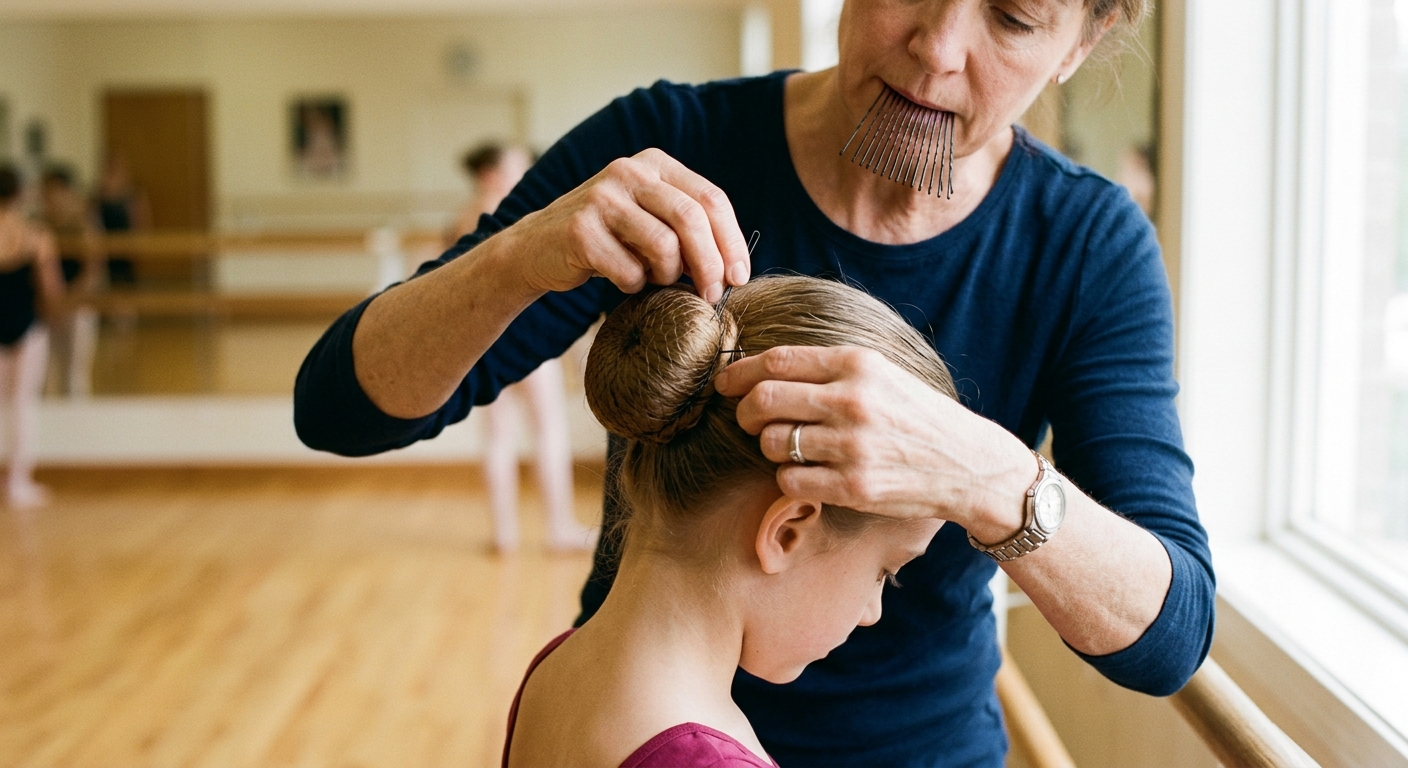
The Stage Bun: A Step-by-Step Approach
A sleek, secure bun is the workhorse of recital hair. Here’s a method that holds through curtain calls and cartwheels alike:
- Start with day-old hair — slightly dirty hair holds better than freshly washed. If you washed it the night before, that’s ideal.
- Brush thoroughly and apply gel — work a strong-hold gel through from roots to ends before forming the ponytail.
- Create a high, tight ponytail — position it where you want the center of the bun to sit.
- Twist the ponytail into a rope, then coil it around the base and secure with another elastic.
- Pin systematically — push bobby pins in at the clock positions (12, 3, 6, 9) first, then fill in the gaps. Pins should go into the bun and back through to catch the base.
- Hairnet over the top — match it to the dancer’s hair color; this is what separates a polished stage bun from one that falls apart in Act Two.
- Finish with hairspray — and then more hairspray.
Stage Makeup for Young Dancers
For younger dancers, less is more — but some stage makeup genuinely helps features read from the audience. A light approach:
- Foundation or tinted moisturizer to even out skin tone under hot lights
- Blush applied slightly higher than you’d wear it normally
- Mascara (for ages 8+ as appropriate for your studio’s guidelines) in black or brown
- A lip color — even a tinted balm registers better than bare lips on stage
- Setting spray or powder to prevent shine under performance lighting
Always check your studio’s recital guidelines — Dance Factory Dover and most studios provide specific hair and makeup requirements for each production. When in doubt, ask your teacher.
Hair and Makeup Checklist
- Gel, hairspray (travel-size is fine)
- Bobby pins (in hair color match)
- Hair elastics — multiple
- Hair net(s) in matching color
- Fine-tooth comb and paddle brush
- Any decorative hair pieces specified by the studio
- Stage-appropriate makeup (per studio guidelines)
- Setting spray or translucent powder
- Cotton swabs and makeup remover — for clean-up between acts
Managing Recital Day Nerves
Here is something worth saying plainly: your energy sets the temperature in the room. Children are exceptional at reading their parents’ anxiety, and recital day is high-stakes enough without absorbing adult stress on top of their own.
The good news is that what your child is feeling — that fluttery, electric, jittery feeling — is the same thing every performer feels before going on. The goal isn’t to eliminate nerves. It’s to help them understand that nerves and excitement feel almost identical, and that the feeling means something wonderful is about to happen.
Before You Leave the House
- Do a full run-through the night before — costume on, hair practiced, shoes tied. Solving problems at 8 PM is infinitely better than solving them at 8 AM.
- Lay everything out — bag packed, costume hung, shoes by the door. Morning-of decisions are where forgotten items live.
- Get a good night’s sleep — it sounds obvious, but a rested child handles the unpredictability of a long recital day far better.
- Eat a real breakfast — nerves suppress appetite, but fuel matters. Eggs, oatmeal, or toast — something with staying power.
At the Venue
- Arrive early — rushing is the enemy of calm. Give yourself a buffer, and then add fifteen minutes to that.
- Talk about what to expect — walk through the sequence: “First we’ll check in, then go to the dressing room, then there’ll be a warm-up, then we wait, and then it’s your turn to shine.”
- Redirect, don’t dismiss — if they say “I’m nervous,” don’t say “Don’t be nervous!” Try: “I know that feeling. Your body is getting ready to do something exciting.”
- Let them feel proud of the preparation — remind them how many classes they attended, how many times they practiced, how much they’ve grown. They’ve already done the hard part.
What to Do If They’re Struggling Backstage
Some children do experience genuine stage fright, and that’s okay. A few things that help:
- Breathing exercises — breathe in for four counts, hold for four, out for four. Simple, and it genuinely works.
- A comfort object in the bag — a small stuffed animal or a note from home that they can hold backstage is often enough.
- Focus on one person — tell them to find your face in the audience when they first walk out. That single point of connection can be grounding.
- Celebrate the attempt, not just the outcome — stepping onto a stage is brave. Make sure they know you believe that regardless of how the performance goes.
Recital Day Parent Checklist
- Costume(s) packed and labeled the night before
- Arrival time confirmed (check studio communications)
- Emergency kit assembled and at the top of the bag
- Snacks and water packed
- Camera / phone charged; check photography policy for your studio
- Flowers or post-show treat arranged (optional but memorable)
- Parking and venue layout reviewed
- Volunteer duties confirmed if applicable
- Younger siblings entertained and planned for during the wait
Downloadable PDF Checklist: Print It, Post It, Pack It
Everything above, distilled into a clean one-page checklist you can print and stick to the fridge the week before recital day.
📥 Download the Free PDF Version
Want a print-ready version? We’ve put together a clean, one-page PDF version of this checklist — designed to stick to the fridge or tuck right into your dance bag.
Download the Dance Recital Survival Checklist (PDF) →
No email required. Just a gift from our studio family to yours.
One Final Thing
Recital day is one of those ordinary extraordinary days — the kind that your child won’t remember the specific steps of, but will remember exactly how it felt. They’ll remember whether they felt ready, whether they felt supported, and whether the grown-ups around them believed in them.
You already know what you’re doing. You’ve shown up to every rehearsal, sewn on every button, and driven to every class. The checklist just makes sure nothing falls through the cracks so that you can spend recital day doing the most important thing: watching someone you love do something that makes them feel alive.
That’s what dance is for.
Ready to get your child started on their dance journey? Dance Factory Dover offers classes for ages 2 and up in ballet, tap, jazz, hip hop, and more — right here in Dover, Delaware.
Check our class schedule or contact us to learn more about enrollment.
 The Dance Factory